For most of human history, milk was never a uniform, standardized product. It was local. Seasonal. Shaped by climate, by soil, by the animals themselves, and by the way people lived alongside them.
In India, milk didn’t arrive through stainless steel pipelines and refrigerated tankers. It came from living systems: from cows adapted over thousands of years to heat, drought, disease, and long coexistence with human communities. Every glass of milk was, in a quiet way, an expression of evolution.
That context matters today because modern dairy has largely moved in the opposite direction. Over the past century, milk production has been optimized primarily for volume: more yield per animal, more consistency per batch, more efficiency per acre. The biological cost of that shift rarely enters everyday conversation. But it shows up in subtle places: digestion, metabolic response, nutrient absorption, and how the body experiences dairy.
Gir cow milk belongs to a much older story.
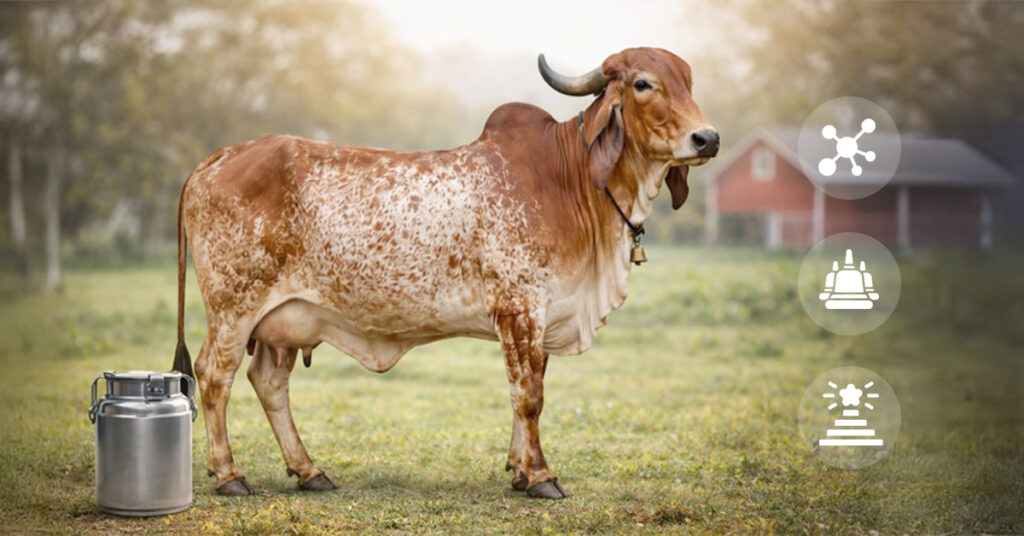
The Gir breed evolved in the Kathiawar peninsula of Gujarat over roughly 4,000 years, shaped not in laboratories or breeding centers, but by environment, survival, and natural selection. Heat. Scarcity. Disease pressure. Human agriculture. These forces didn’t create the highest-yielding cow. They created a resilient one.
And resilience leaves biochemical fingerprints.
This article explores what modern science currently understands about Gir cow milk; not as folklore, not as marketing mythology, but as biology. Its proteins. Its fats. Its minerals. Its enzymes. And the production choices that determine whether those natural properties survive the journey from animal to human body.
The Gir Cow: Shaped by Environment, Not Industry
The Gir breed developed in a region where survival demanded efficiency, not excess. Extreme heat, fluctuating fodder, endemic pathogens, and seasonal scarcity did not reward animals that overproduced. They favored animals whose internal systems stayed balanced.
Over generations, this selected for cows with strong heat tolerance, resilient immune responses, stable temperaments, and reproductive cycles aligned with natural seasons. These are not just agricultural traits. They are metabolic traits. They determine how nutrients are partitioned in the body, how stress hormones fluctuate, and how milk is synthesized at the cellular level.
Unlike many modern dairy breeds, which were intensively selected in recent history to maximize yield, Gir cows were never pushed in that direction. As a result, certain ancestral characteristics remain dominant in the breed. One of those is the natural production of exclusively A2 beta-casein protein.
Why Gir Cow Milk Often Feels Different to Drink
When people describe discomfort with milk, they rarely talk about proteins. They talk about heaviness, bloating, cramps, sluggish digestion, or a sense that milk “doesn’t sit well.” Those sensations are real physiological responses to how milk breaks down and moves through the gut.
Gir cows naturally produce milk containing A2 β-casein rather than the mixed or predominantly A1 forms found in many high-yield modern breeds. During digestion, these two behave differently. A1 digestion is more likely to release BCM-7, a peptide that interacts with opioid receptors in the gastrointestinal tract and has been associated in studies with changes in gut motility and transit time. A2 digestion produces little to no BCM-7.
In small human trials, people who report milk sensitivity experience fewer digestive symptoms when consuming A2 milk compared to conventional mixed milk. The research is still developing, and claims about major disease links remain unproven. But the digestive difference is not theoretical. It shows up as how the stomach and intestines respond after a glass of milk.
For the everyday consumer, this matters because digestion is not an academic outcome. It is comfort. Energy. Whether milk feels nourishing or burdensome.
Gir milk removes one of the biochemical triggers that often complicates that experience.
Minerals That Actually Reach the System
Milk is often recommended for minerals, but the presence of minerals does not guarantee their usefulness. Absorption depends on the chemical form in which those minerals exist and the digestive environment they encounter.
Gir milk naturally contains calcium, phosphorus, magnesium, potassium, zinc, and selenium in organically bound forms rather than synthetic fortifications. These naturally chelated minerals are typically more bioavailable, meaning the body can transport and utilize them more efficiently.
This matters at life stages where digestion is compromised or nutritional demand is high: childhood growth, pregnancy, aging, illness, or chronic stress. Calcium supports skeletal structure, magnesium regulates muscle and nerve function, potassium maintains cellular hydration and heart rhythm, and trace minerals support immune regulation and antioxidant systems.
Here, Gir milk functions less like a supplement and more like a biological delivery system, offering nutrients in the form human physiology evolved to recognize.
The Living Layer of Gir Cow Milk
Beyond fats and proteins, fresh milk contains enzymes, bioactive peptides, and vitamins that interact with gut bacteria, immune signaling, and metabolic regulation. These compounds are among the most sensitive components of milk. They respond directly to heat, hormonal manipulation, chronic stress in animals, and aggressive processing.
When cows live under persistent physiological strain, it shows up in their milk as altered vitamin levels, inflammatory markers, and measurable stress hormones. When lactation is artificially accelerated, enzymatic activity and protein structures change.
Milk records the internal state of the animal.
So the conversation about Gir milk cannot stop at genetics. It must include how the cow lives.
Technical Profile of A2 Gir Cow Milk
Gir cow milk is naturally characterized by a biochemical profile shaped by the breed’s long evolution and low-intervention physiology.
Protein composition:
Gir cows produce milk containing exclusively A2 β-casein. During digestion, A2 β-casein is resistant to cleavage at position 67, resulting in minimal release of beta-casomorphin-7 (BCM-7). Digestion primarily yields BCM-9 and other peptides with different biological activity.
Fat architecture:
Gir milk contains a higher proportion of short- and medium-chain fatty acids, naturally smaller and well-emulsified fat globules, conjugated linoleic acid (CLA), and a balanced omega-3 to omega-6 profile.
Mineral composition and bioavailability:
Gir milk provides calcium, phosphorus, magnesium, potassium, zinc, and selenium predominantly in naturally chelated forms. Organic mineral binding supports higher absorption efficiency compared to synthetic fortification.
Vitamins and bioactive components:
Gir milk contains fat-soluble vitamins A, D, E, and K, B-complex vitamins, and naturally occurring enzymes and bioactive peptides that support gut and immune function. These components are sensitive to heat stress, hormonal intervention, and intensive processing.
Production sensitivity:
Milk composition is influenced by animal stress levels, housing systems, feed quality, and milking practices. Chronic stress and hormonal acceleration are associated with altered vitamin levels, elevated inflammatory markers, and changes in enzymatic activity.
Gir Cow Milk Beyond A2 Milk Discussions
Most people today start their milk decision with one question: is it A2 or not? That makes sense. Protein composition affects digestion, and many people feel better on A2 milk than on conventional milk.
But stopping the conversation there misses something important.
A2 is not a feature you add to milk. It is something milk either carries naturally, or is selectively filtered for. Different animals can produce A2 protein. Even within cows, herds can be tested and separated. That tells you something about the protein. It does not tell you much about the milk.
Gir cows were never converted to A2. They never moved away from it. Their milk has been A2 for thousands of years, as part of a breed that evolved under Indian environmental conditions, not modern production targets. The protein exists inside a milk system that developed together over time: how fats are structured, how minerals are bound, how enzymes remain active, and how the animal’s metabolism regulates what enters the milk.
This is why Gir cow milk is not just “another A2 option.” It is the most natural and biologically consistent form of A2 milk.
At AMOYA, A2 is treated as the starting point, not the claim. What defines the milk is the breed and the way the cow lives: natural grazing, no hormonal forcing, low stress, and gentle handling. Because milk quality is not created in a lab. It is built every day inside the animal.
Gir cow milk represents what A2 was always supposed to be: not a corrected product, but an original one.
Why Production Cannot Be Separated from Nutrition at AMOYA
At AMOYA, purposeful production begins with a refusal to override the cow’s biology.
Gir cattle are allowed natural movement and free grazing, supporting metabolic balance and lower stress hormone expression. They are not subjected to hormonal injections to force yield beyond natural lactation rhythms. Feed remains plant-based and aligned with digestive design. Milking is conducted gently, respecting physiological let-down rather than extracting against it.
Lower chronic stress supports more stable milk composition. Natural lactation preserves protein structure and enzymatic activity. Free movement influences fat synthesis. The absence of hormonal forcing avoids residues and endocrine disruption within the milk itself.
The result is not simply “clean” milk. It is milk that has not been metabolically distorted.
At AMOYA, milk is not optimized for maximum extraction. It is optimized for physiological compatibility.
“Purposeful purity” means respecting what evolution already engineered. Letting natural processes guide nutrition. Because purity is not only about what is removed from milk.
It is about what is never disrupted in the first place.